
Can You Do Physical Therapy Online? What to Expect from Your First Telehealth PT Visit
Written by Connor Sheeks PT, DPT · Published July 2026 · Last reviewed July 2026
Reading time: approximately 7 minutes
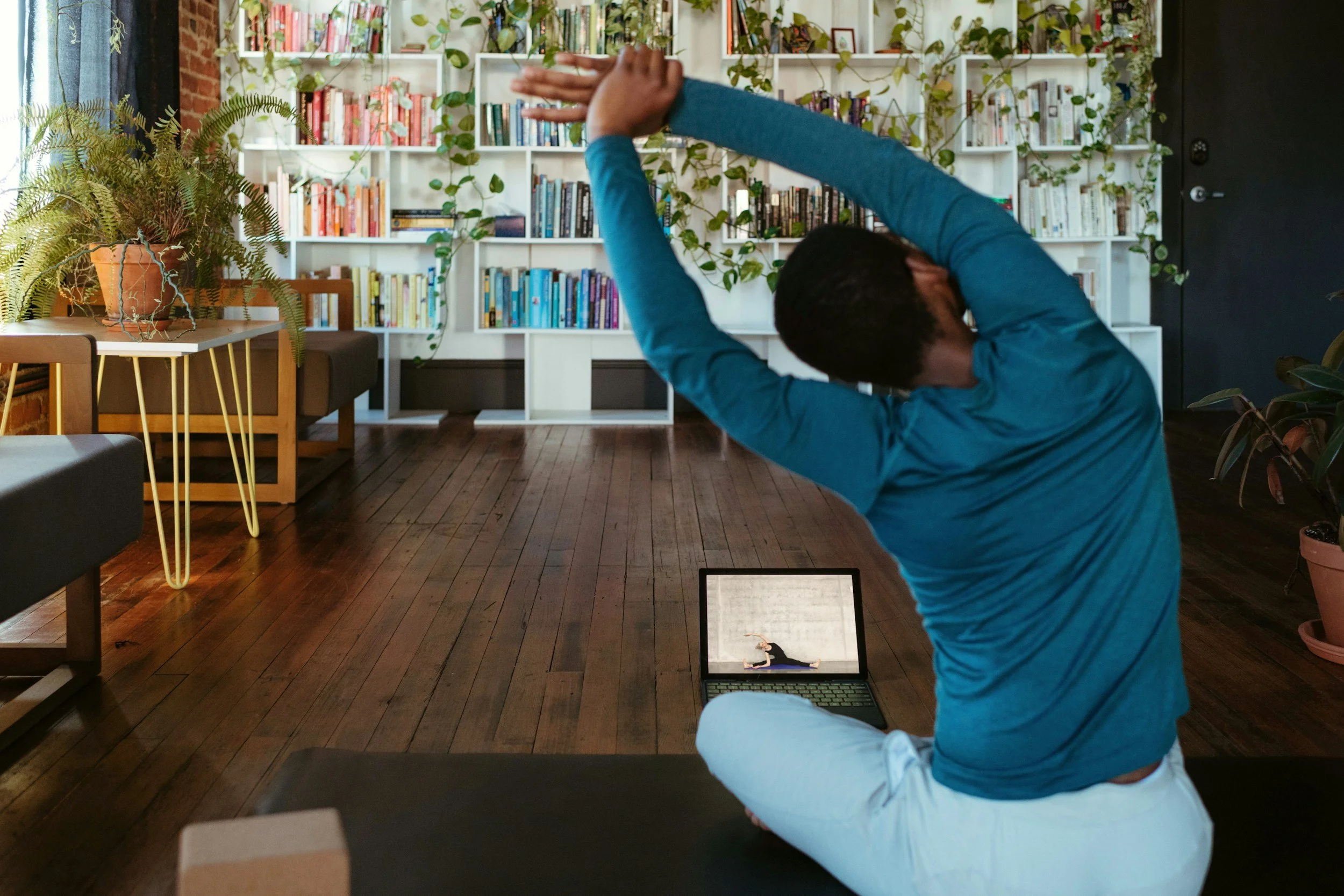
If you have been thinking about telehealth physical therapy but have not pulled the trigger yet, the hesitation is usually the same: you know what an in-person PT appointment looks like. You have no idea what a virtual one looks like. And starting something unfamiliar when you are already dealing with pain feels like one more thing to figure out.
This article removes that uncertainty. We are going to walk through exactly what happens before, during, and after your first telehealth PT session at Spine33 Rehab, what you need to prepare, what we are actually doing on our end, and what you can realistically expect to get out of it.
What you will learn in this article
What you need to get started with telehealth PT
What happens before your first session
A step-by-step breakdown of what a first evaluation looks like
What we are assessing and why during the movement evaluation
What you will leave your first session with
What follow-up sessions look like and how the program evolves
Honest answers to the most common concerns about virtual PT
What You Need to Get Started
The technical requirements for telehealth PT are minimal. If you have used a video call before, you have everything you need.
What you need for your first session:
Device: a smartphone, tablet, laptop, or desktop computer with a front-facing camera
Connection: a stable wifi or cellular connection. Standard home internet is sufficient.
Space: enough room to stand, sit on the floor, and take a few steps in any direction
Clothing: comfortable clothes you can move in. Athletic wear or shorts and a t-shirt work well.
Optional: a yoga mat or carpet for floor exercises
That is it. No special equipment required before your first session.
One thing worth knowing: the camera angle matters more than most people expect. For a movement assessment, we need to see your whole body, not just your face. Before your session, test your setup by propping your device so the camera captures you from head to foot when you are standing. A stack of books, a laptop stand, or leaning your phone against a wall all work fine.
Before Your First Session
After booking your evaluation, you will receive intake paperwork to complete before your appointment. This covers your medical history, current symptoms, prior treatments, medications, imaging reports if you have them, and your functional goals. Completing this thoroughly helps us use session time on assessment and treatment rather than basic history-gathering.
We review your intake before the session begins. By the time we connect on video, we already have a picture of your history and can focus the evaluation on the clinical questions most relevant to your presentation.
What to bring to your first session:
Any imaging reports you have: MRI, X-ray, CT. You do not need to have imaging. If you do, it is helpful.
A list of previous treatments and providers, including what helped and what did not
Your main functional goals, meaning what you want to be able to do that you currently cannot
Any questions you have written down in advance
Your First Session: Step by Step
A first evaluation at Spine33 Rehab runs 60 minutes. Here is what is involved in those minutes.
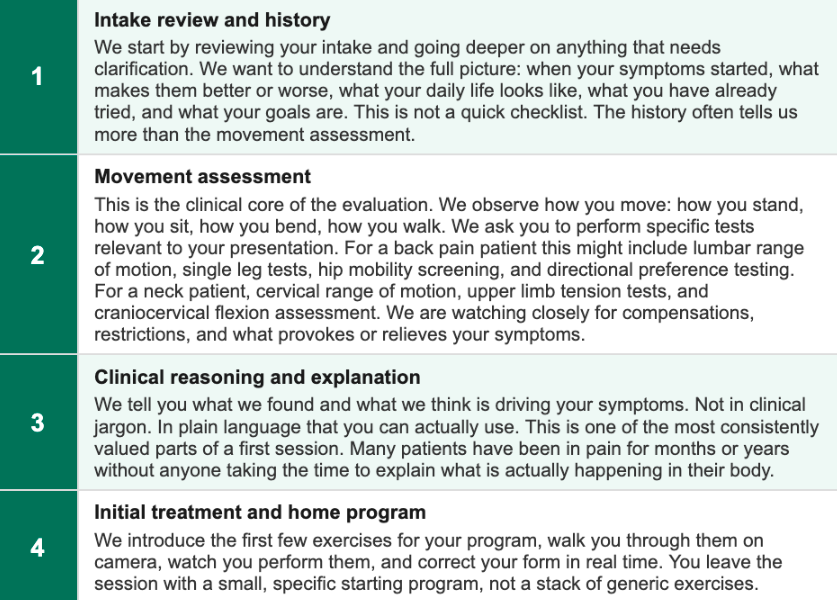
What We Are Actually Assessing During the Movement Evaluation
Telehealth movement assessment is not the same as watching someone exercise. It is a structured clinical observation with specific diagnostic targets. Here is what we are looking for:
Movement quality and compensations. How you move tells us which structures are overloaded, which are restricted, and which movement patterns are contributing to your pain. A patient who avoids lumbar extension in every movement tells us something different from one who avoids flexion.
Directional preference. For patients with disc herniation or discogenic pain, we are looking for the movement direction that centralizes symptoms. We will ask you to perform repeated movements in specific directions and tell us what happens to your symptoms. This information directly drives the first phase of your program.
Neurological screening. We assess reflexes, muscle strength patterns, and sensory changes through observation and specific tests that translate well to video. For patients with radicular symptoms, this helps identify the likely nerve root level and guides our clinical reasoning.
Load tolerance. We observe how your spine and hips handle simple loaded tasks. Single leg stance, a bodyweight squat, a forward bend with load. These tests tell us where you are in the rehabilitation process and what starting load is appropriate for your program.
Your environment. In a telehealth session we can see your actual space. If you are a desk worker with neck pain, we can look at your workstation setup in real time. That clinical context is not available in a clinic and it directly improves how we design your program.
What You Leave Your First Session With
By the end of your evaluation you will have four things:
A clear explanation of what is driving your symptoms and why
A specific starting exercise program, typically three to five exercises, with video demonstrations and written instructions
A plan for how your program will progress over the coming weeks
Answers to your questions about your condition, your timeline, and what to expect
We do not give generic exercise handouts. Every program is built specifically for your presentation, your space, your equipment, and your goals. If you have a particular activity you want to return to, that goes into the program design from session one.
What Follow-Up Sessions Look Like
Follow-up sessions at Spine33 Rehab are 45 minutes and are fully one-on-one with us for the entire duration. Each session follows a consistent structure:
Check-in: How did the week go? What improved? What flared? What questions came up? This is clinical data that tells us whether the program is working and what needs to adjust.
Movement reassessment: We recheck key movement findings from the prior session to track progress and identify where to push forward and where to back off.
Program progression: We advance your exercises, increase load or complexity, or modify based on your response. A program that does not evolve based on your progress is a template, not a treatment.
Education: Each session includes education relevant to where you are in your recovery. Pain neuroscience, activity modification, understanding your imaging, return to sport or work considerations. The specifics depend on what matters most for you that week.
Honest Answers to Common Concerns
What if I need hands-on treatment?
Some presentations do benefit from hands-on manual therapy. Cervicogenic headache, for example, responds well to upper cervical joint mobilization that cannot be fully replicated via video. For patients whose presentation clearly indicates they need hands-on care as a primary tool, we will tell you that directly during your evaluation and can help you identify an appropriate in-person provider. We do not take on cases where in-person care is clearly the superior option without having that honest conversation first.
For most chronic spine conditions, the primary treatment drivers are exercise, education, and progressive loading, all of which are fully deliverable via telehealth.
What if I am not comfortable with technology?
Most patients who express concern about this before their first session tell us afterward that it was simpler than they expected. If you can use a smartphone camera, you can do telehealth PT. Before your first session, we send clear setup instructions. If you have any technical issues connecting, we troubleshoot with you directly.
Can you really see what you need to see over video?
For the purposes of a movement assessment, yes. We are watching posture, movement quality, compensatory patterns, and symptom response to specific tests. These are all observable on video. The camera angle you set up before the session matters more than the resolution of your device. A wide-angle view of your whole body tells us more clinically than a close-up face shot.
What if my symptoms change between sessions?
We provide direct access between sessions for questions about your program or symptom changes. If something unexpected happens, such as a significant flare, new neurological symptoms, or uncertainty about whether to continue an exercise, you can reach us without waiting for your next scheduled appointment.
When to contact us or seek care outside of your scheduled session:
New or worsening numbness, tingling, or weakness in an arm or leg
Loss of bladder or bowel control alongside spine symptoms
Significant symptom worsening that does not settle within 24 to 48 hours
Any fall or trauma affecting your spine
For any symptom that feels like a medical emergency, contact emergency services directly.
Key Takeaways
All you need for telehealth PT is a device with a camera, stable internet, and enough space to move. No special equipment required.
Your first session runs 60 minutes and covers a detailed history, structured movement assessment, clinical explanation of your findings, and your starting exercise program
We review your intake before the session so we can focus evaluation time on clinical assessment rather than basic paperwork
The movement assessment in telehealth PT is a structured diagnostic observation, not just watching you exercise. Camera angle matters more than device quality.
You leave your first session with a specific explanation of your condition, a tailored starting program, and a clear plan for how your care will progress
Follow-up sessions are 45 minutes, fully one-on-one, and include check-in, reassessment, program progression, and education
For presentations where hands-on care is clearly the better option, we will tell you directly rather than proceeding with telehealth
Frequently Asked Questions
Do I need a referral to start telehealth physical therapy?
No. Tennessee allows direct access to physical therapy without a physician referral. You can book an evaluation at Spine33 Rehab directly without needing to see a doctor first. If your presentation indicates you need a medical evaluation before starting PT, we will tell you that at your first session.
What platform do you use for telehealth sessions?
We use a HIPAA-compliant video platform. You will receive a secure link before your appointment that opens directly in your browser. No app download is required. The platform works on any modern smartphone, tablet, or computer.
How long is each session and how often will I be seen?
Your initial evaluation is 60 minutes. Follow-up sessions are 45 minutes. Most patients are seen once per week during their course of care, with some choosing to start at twice weekly during the acute phase. Session frequency is determined by your clinical needs and your schedule, not by a standard protocol.
What if I need equipment for my exercises?
We build your program around what you actually have at home. Most exercises in the early phases of a spine rehab program require no equipment beyond a floor and a wall. As your program advances, we may incorporate resistance bands, a foam roller, or light weights. We will discuss any equipment needs before introducing exercises that require them.
Can I do telehealth PT if I am not in Tennessee?
Currently, Spine33 Rehab is licensed to practice in Tennessee. We are actively pursuing licensure in additional states. If you are located outside Tennessee, contact us and we can let you know whether we are currently able to see patients in your state.
What happens at the end of my course of care?
When you have reached your functional goals, we transition you to an independent home program. You leave with a written program, video demonstrations, and clear guidance on how to maintain your gains and manage any future flares independently. We are not aiming to keep you in ongoing treatment indefinitely. The goal is to make you self-sufficient.
Ready to see what your first session looks like?
Book a free 15-minute discovery call with us at Spine33 Rehab. We will talk through your history and symptoms, answer any questions about the telehealth process, and let you know whether we are a good fit for what you are dealing with.
spine33rehab.com | Book Your Free Call
About the Author
Dr. Connor Sheeks PT, DPT is a licensed physical therapist and the founder of Spine 33 Rehab PLLC, a cash-pay telehealth physical therapy practice specializing in virtual spine rehabilitation. He holds a Doctor of Physical Therapy (DPT) degree and has clinical experience treating chronic low back pain, lumbar disc herniation and radiculopathy, cervicogenic headache, lumbar spinal stenosis, postural dysfunction, and many other spinal pathologies. Spine33 Rehab currently serves patients in Tennessee via telehealth and is actively pursuing licenses in other states.
References
Mani S, et al. (2017). Effectiveness of telerehabilitation interventions in persons with chronic musculoskeletal conditions: a systematic review. Physical Therapy Reviews. doi:10.1080/10833196.2017.1337806
Cottrell MA, et al. (2017). Real-time telerehabilitation for the treatment of musculoskeletal conditions is effective and comparable to standard practice. Disability and Rehabilitation. doi:10.1080/09638288.2016.1224171
American Physical Therapy Association. (2023). Telehealth in Physical Therapy. apta.org