
Stenosis and Walking: Why It Hurts and How to Manage It
Written by Connor Sheeks PT, DPT · Published September 2026 · Last reviewed September 2026
Reading time: approximately 7 minutes

You used to walk a mile without thinking about it. Now you make it two blocks before your legs feel heavy, start to ache, or go numb. You sit down, feel better within a few minutes, and start again. A block later the same thing happens.
If that pattern is familiar, you are likely experiencing neurogenic claudication, the hallmark walking symptom of lumbar spinal stenosis. It is one of the most functionally disruptive symptoms in spine care, and it is one of the most misunderstood.
This article explains exactly why walking with stenosis produces those symptoms, how the pattern differs from other causes of leg pain with walking, and what the evidence shows about managing it effectively to extend your walking distance and protect your independence.
What you will learn in this article
Why lumbar stenosis causes leg symptoms specifically with walking and standing
What neurogenic claudication is and how it differs from vascular claudication
The anatomy of why certain positions provide relief
Strategies with evidence for extending walking tolerance
How a rehabilitation program addresses neurogenic claudication specifically
When symptoms require surgical evaluation
Why Walking Hurts with Lumbar Stenosis
The short answer: upright walking compresses your already narrowed spinal canal, reducing blood flow and space for the nerve roots inside it. Understanding the mechanism in more detail changes how you manage it.
The dynamic nature of spinal stenosis
Lumbar spinal stenosis is not a fixed, static narrowing. The dimensions of the spinal canal change with movement and position. In lumbar extension, the position your spine is in when you stand upright and walk, several things happen simultaneously that reduce canal space:
The ligamentum flavum, the ligament running along the back wall of the spinal canal, buckles inward
The facet joints approximate and may protrude slightly into the canal
The overall diameter of the spinal canal decreases measurably
In lumbar flexion, the position your spine is in when you sit, lean forward, or bend over, the opposite occurs. The ligamentum flavum is pulled taut and flattens against the canal wall, the facet joints separate slightly, and the available space for neural structures increases. This is why sitting and forward bending consistently relieve symptoms.
Neurogenic claudication: what is actually happening in your legs
When the spinal canal narrows during upright walking, the cauda equina nerve roots inside experience increased pressure. This pressure impairs blood flow to the nerve roots themselves, a phenomenon called ischemia. The result is a combination of pain, heaviness, cramping, numbness, and tingling in the legs that builds progressively with walking and resolves with rest or forward flexion.
This is not the same as muscle fatigue or circulatory leg problems. The legs themselves are structurally healthy. The problem is the neural input to those legs being progressively compromised as walking continues in the extension-loaded upright posture.
The recovery that occurs when you sit down is almost immediate compared to vascular causes of leg pain, often within one to five minutes, because you are relieving the neural compression rather than waiting for blood to return to ischemic muscle tissue. This rapid recovery with flexion is one of the defining clinical features of neurogenic claudication.
Neurogenic vs. Vascular Claudication: Why the Distinction Matters
Both neurogenic and vascular claudication produce leg pain with walking that resolves with rest. They are frequently confused and in older adults can coexist. Distinguishing them matters because the management is completely different.
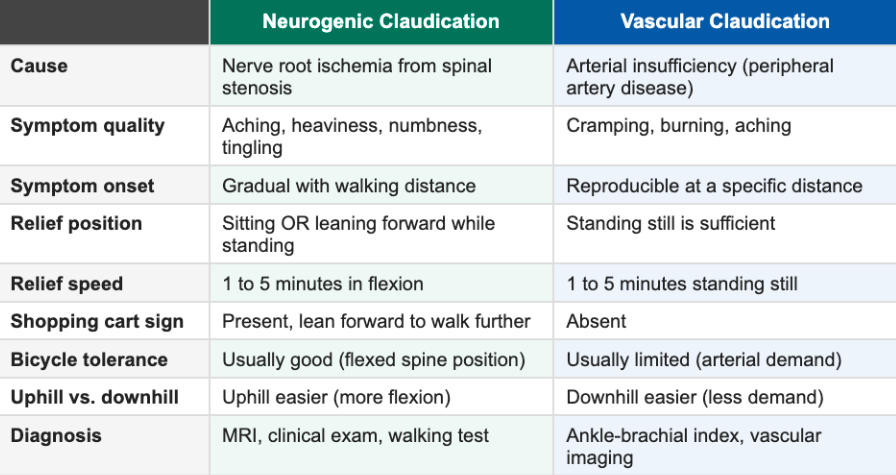
A key clinical pointer: if you can walk further when leaning forward on a shopping cart than when walking upright, this strongly suggests neurogenic claudication from stenosis rather than vascular disease. If stopping and standing still relieves your symptoms just as quickly as sitting down, vascular claudication may be more likely. When in doubt, both a physical therapy evaluation and a vascular assessment are appropriate.
Practical Strategies for Extending Walking Tolerance
The goal is not to avoid walking. Walking, with appropriate modification, is both safe and important for people with lumbar stenosis. The following strategies have evidence or strong clinical rationale for extending walking distance and quality of life.
Use the shopping cart position
The most immediately practical intervention for most stenosis patients is using a walking aid that allows slight forward lean: a shopping cart, a wheeled walker, or a rollator. Leaning forward on these aids places the lumbar spine in relative flexion while walking, increasing canal diameter and often dramatically extending the distance that can be covered before symptoms onset.
This is not a weakness or a defeat. It is applying the mechanical principle that explains your symptoms directly to your daily life. Many patients go from a one-block walking tolerance to covering a full grocery store or a park loop with this modification.
Interval walking with planned rest breaks
Rather than pushing through symptoms until they become severe, interval walking uses planned rest breaks in a forward-flexed position before symptoms peak. The approach: walk to approximately 70 to 80 percent of your symptom threshold, take a two to three minute seated or forward-flexed rest, then continue. Over weeks, walking intervals lengthen as conditioning improves.
Research on neurogenic claudication management consistently shows that structured interval walking outperforms either walking until severe symptoms or avoiding walking altogether. The key is that the rest position must be flexion-biased, sitting or leaning forward, not simply standing still.
Stationary cycling as a walking alternative
Stationary cycling keeps the lumbar spine in relative flexion throughout the activity, avoiding the extension loading that provokes neurogenic claudication. Most stenosis patients can tolerate significantly more cardiovascular exercise on a stationary bike than walking upright, making it an important tool for maintaining fitness and lower extremity conditioning when walking tolerance is significantly limited.
Building cycling capacity also improves the muscular endurance in the hip extensors and lower extremities that supports better walking tolerance over time.
Flexion-biased exercises before walking
Performing a short series of lumbar flexion exercises, including knees to chest, posterior pelvic tilts, and seated forward bends, before walking creates a temporary increase in neural mobility and reduces the accumulated compressive load on the spinal canal. Many patients find this preparation meaningfully extends their initial walking tolerance.
Choosing terrain and routes strategically
Uphill walking requires a slightly more forward-flexed trunk posture than level or downhill walking, which many stenosis patients find more tolerable than expected. Flat, smooth surfaces allow for the most consistent pacing. Downhill walking increases lumbar extension demands and is often the most provocative terrain. Planning routes around these factors is a practical way to maximize walking distance.
A practical walking session structure for stenosis
Before walking: 5 minutes of lumbar flexion exercises (knees to chest, posterior pelvic tilt, seated forward bend)
During walking: use a forward-leaning aid if available; walk at a comfortable pace; rest in a seated or forward-flexed position when symptoms reach 6 out of 10
Rest break: sit or lean forward for 2 to 3 minutes until symptoms fully resolve before continuing
After walking: note total distance and number of rest breaks; aim to gradually increase distance over weeks, not days
Progress marker: decreasing number of rest breaks needed for the same distance, or increasing total distance with the same number of breaks
What Physical Therapy Addresses Beyond Walking Modifications
Walking modifications manage symptoms in the short term. Physical therapy addresses the underlying factors that determine how much stenosis limits your function over time.
Hip flexor stretching. Tight hip flexors increase lumbar lordosis during walking, adding to the extension load on an already compromised canal. Systematic hip flexor stretching is one of the highest-yield early interventions for improving walking tolerance.
Gluteal and hip strengthening. Strong hip extensors and abductors reduce the mechanical demands on the lumbar spine during each walking stride. Weaker hips shift more load to the lumbar segments with each step, accelerating symptom onset.
Core endurance in neutral and flexed positions. Building the endurance of the trunk stabilizers reduces the rate of lumbar extension drift that occurs with fatigue during prolonged walking. A trunk that drifts into extension as you tire will hit your symptom threshold sooner.
Thoracic mobility. Stiff thoracic extension forces compensatory lumbar extension during upright walking. Improving thoracic mobility allows more of the extension demand to be distributed into the thoracic spine rather than concentrated in the stenotic lumbar segments.
Education on long-term management. Stenosis does not resolve the way disc herniation often does. Understanding how to structure activity, pace walking, recognize flare patterns, and maintain a long-term exercise habit is as important as the exercise program itself.
When Walking Limitation Requires Surgical Evaluation
For most patients with neurogenic claudication, conservative management produces meaningful improvement in walking tolerance and quality of life. Surgical evaluation becomes appropriate when:
Walking tolerance is so severely limited that daily function, including basic errands and household activity, is significantly impaired despite quality conservative care
Neurological deficits such as progressive leg weakness are present alongside the claudication symptoms
A meaningful trial of physical therapy, typically 10 to 12 weeks, has not produced adequate functional improvement
Bladder or bowel symptoms are present alongside walking and leg symptoms, which requires urgent evaluation
Laminectomy, which creates more space in the spinal canal by removing the structures causing narrowing, has reasonable evidence for improving walking tolerance in patients with moderate to severe neurogenic claudication. It does not reverse the underlying degenerative process. Post-surgical rehabilitation remains important for maintaining the gains that surgery creates.
Key Takeaways
Neurogenic claudication, the leg pain and heaviness that builds with walking and resolves with sitting or leaning forward, is caused by nerve root ischemia from dynamic spinal canal narrowing in extension
The shopping cart sign, being able to walk further when leaning forward than walking upright, is one of the most reliable clinical indicators of neurogenic claudication from stenosis
Neurogenic claudication and vascular claudication both cause leg symptoms with walking but require completely different management; the two can coexist in older adults
Immediate practical strategies include using a forward-leaning walking aid, interval walking with planned flexion rest breaks, and stationary cycling as a walking alternative
Physical therapy addresses hip flexor tightness, gluteal weakness, core endurance, and thoracic stiffness, all of which affect how quickly symptoms onset during walking
Stenosis does not resolve with conservative care, but most patients achieve meaningful improvement in walking tolerance and daily function with a well-designed, consistent program
Surgical evaluation is appropriate for severe functional limitation unresponsive to quality conservative care, progressive neurological deficits, or bladder or bowel symptoms
Frequently Asked Questions
Why do my legs hurt when I walk but not when I sit?
This is the hallmark pattern of neurogenic claudication from lumbar spinal stenosis. Upright walking places the lumbar spine in extension, which reduces the diameter of the spinal canal and increases pressure on the nerve roots inside. That pressure impairs blood flow to the nerves, producing progressive leg pain, heaviness, or numbness. Sitting places the spine in flexion, which opens the canal and relieves the neural compression, which is why symptoms resolve relatively quickly when you sit down.
How far should I be able to walk with spinal stenosis?
There is no universal answer. Walking tolerance varies significantly by the degree of stenosis, the level and type of narrowing, overall physical condition, and how well the condition is being managed. What matters more than a specific distance is whether your walking tolerance is stable or improving over time with appropriate management. Many patients significantly extend their walking distance with structured interval walking, hip strengthening, and appropriate use of forward-leaning aids.
Does walking make spinal stenosis worse?
Walking does not accelerate the structural progression of stenosis. The underlying degenerative changes continue at their own pace regardless of activity level. What walking does is produce temporary neural compression in the upright position, which causes symptoms. Avoiding walking entirely leads to deconditioning that makes symptoms worse over time. The goal is structured walking with appropriate modification, not avoidance.
Why can I ride a bike but not walk with stenosis?
Cycling keeps the lumbar spine in relative flexion throughout the activity, which increases spinal canal diameter compared to the extension-loaded upright walking posture. The forward-flexed cycling position avoids the dynamic narrowing that produces neurogenic claudication. This is why stationary cycling is one of the most recommended activities for stenosis patients and is often used as a cardiovascular and conditioning tool when walking tolerance is limited.
What is the best walking aid for spinal stenosis?
Any aid that allows you to lean forward while walking is beneficial for neurogenic claudication. A rollator walker with a forward-leaning handle position is the most purpose-suited option. A standard shopping cart works for many patients inside a store. A cane provides some assistance but does not provide the forward lean that mechanically opens the spinal canal. The right choice depends on your degree of symptom limitation and balance needs.
Losing walking distance to stenosis? Let us help you get it back.
Book a free 15-minute discovery call with us at Spine33 Rehab. We will talk through your current walking tolerance, what you have tried, and whether a telehealth spine rehab program is the right fit for where you are.
spine33rehab.com | Book Your Free Call
About the Author
Dr. Connor Sheeks PT, DPT is a licensed physical therapist and the founder of Spine 33 Rehab PLLC, a cash-pay telehealth physical therapy practice specializing in virtual spine rehabilitation. He holds a Doctor of Physical Therapy (DPT) degree and has clinical experience treating chronic low back pain, lumbar disc herniation and radiculopathy, cervicogenic headache, lumbar spinal stenosis, postural dysfunction, and many other spinal pathologies. Spine33 Rehab currently serves patients in Tennessee via telehealth and is actively pursuing licenses in other states.
References
Ammendolia C, et al. (2022). Nonoperative treatment for lumbar spinal stenosis with neurogenic claudication: an updated systematic review. BMJ Open. doi:10.1136/bmjopen-2021-057724
Katz JN, Zimmerman ZE, Mass H, Makhni MC. (2022). Diagnosis and management of lumbar spinal stenosis: a review. JAMA. doi:10.1001/jama.2022.3872
Whitman JM, et al. (2006). A comparison between two physical therapy treatment programs for patients with lumbar spinal stenosis. Spine. doi:10.1097/01.brs.0000227892.21003.7b
Tomkins-Lane C, et al. (2015). ISSLS prize winner: methodology for evaluating walking capacity in lumbar spinal stenosis. Spine. doi:10.1097/BRS.0000000000000835
Delitto A, et al. (2015). Surgery versus nonsurgical treatment of lumbar spinal stenosis: a randomized trial. Annals of Internal Medicine. doi:10.7326/M14-1420