
Surgery vs. Physical Therapy for Disc Herniation: What the Data Shows
Written by Connor Sheeks PT, DPT · Published August 2026 · Last reviewed August 2026
Reading time: approximately 7 minutes

If you have been told surgery might be an option for your disc herniation, you are facing one of the most consequential decisions in spine care. The way that decision is framed matters enormously, and most patients make it without seeing the actual data.
This article presents the evidence directly. Not to push you toward or away from surgery, but to give you what the research actually shows about outcomes, timelines, and which patients benefit from each path. The goal is an informed decision, not a predetermined one.
What you will learn in this article
What the landmark clinical trials comparing surgery and PT actually found
Where surgery produces superior outcomes and where it does not
The specific indications that make surgery appropriate
What quality conservative care looks like before surgery is considered
How to evaluate whether you have genuinely exhausted conservative options
What the Major Trials Show
The most important evidence on this question comes from a series of randomized controlled trials and prospective cohort studies conducted over the past three decades. The findings are consistent enough to draw clear conclusions.
The SPORT trial
The Spine Patient Outcomes Research Trial, known as SPORT, is the largest and most cited study comparing surgery and non-operative treatment for lumbar disc herniation. Published in JAMA in 2006 and followed for up to eight years, it enrolled over 1,200 patients across multiple centers.
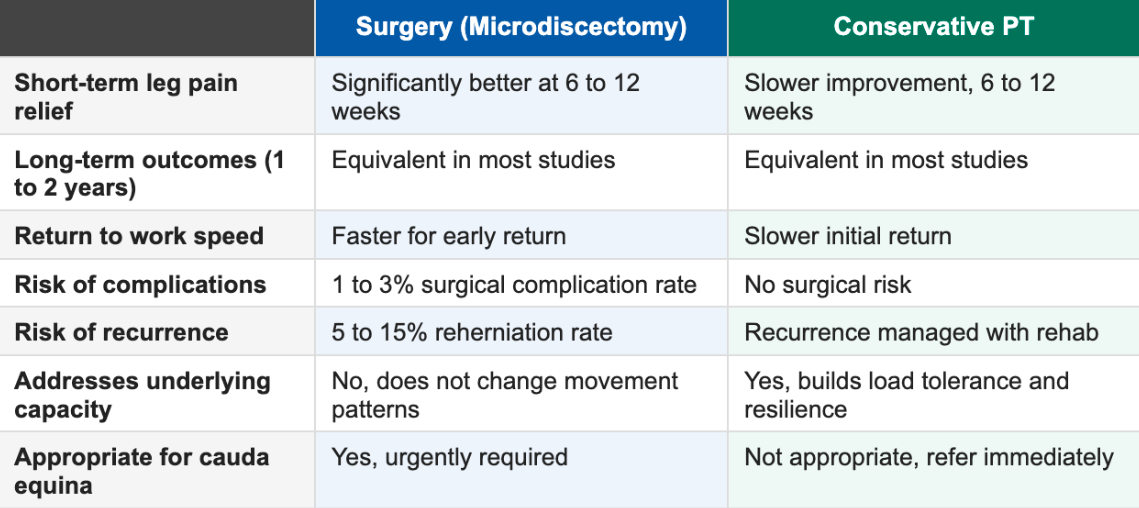
The headline finding: patients who received surgery experienced faster and more substantial early improvement in leg pain and function than those treated non-operatively. At six weeks and three months, surgical patients had meaningfully better outcomes.
The equally important finding: by one to two years, the outcomes of both groups had converged. Non-operative patients who improved did so to a similar degree as surgical patients. At four-year and eight-year follow-up, there were no statistically significant differences in primary outcomes between the two groups.
The Weber trial and subsequent studies
A 1983 Norwegian randomized trial by Weber followed disc herniation patients for ten years. At one year, surgically treated patients had better outcomes. By four years, differences were no longer significant. At ten years, outcomes were equivalent.
Multiple subsequent trials have replicated this pattern. Surgery produces faster early relief, particularly of leg symptoms. Long-term outcomes are generally equivalent between surgery and quality conservative care in patients who do not have clear surgical indications.
The consistent finding across trials:
Surgery for disc herniation produces faster relief of leg pain and neurological symptoms in the short term.
By one to two years, outcomes between surgery and quality conservative care have largely converged in patients without clear surgical indications.
The decision is not surgery versus no treatment. It is surgery now versus quality conservative care with the option of surgery if conservative treatment fails.
Where Surgery Produces Superior Outcomes
The convergence of long-term outcomes does not mean surgery is equivalent in all cases. There are specific presentations where surgery produces clearly superior results.
Cauda equina syndrome
Cauda equina syndrome, characterized by bladder or bowel dysfunction and saddle area numbness alongside disc herniation, is a surgical emergency. Outcomes are time-dependent. Surgery within 24 to 48 hours of symptom onset produces significantly better neurological recovery than delayed intervention. This is not a situation where conservative care is an appropriate first step.
Progressive neurological deficit
Leg weakness that is measurably worsening over days to weeks despite conservative care is an indication for surgical evaluation. The concern is ongoing nerve damage from sustained compression. When the neurological deficit is stable rather than progressive, conservative care remains appropriate.
Severe unremitting radiculopathy
For patients with severe leg pain that has not responded to six to twelve weeks of quality conservative treatment, including appropriate physical therapy, the evidence supports surgical consultation. The SPORT trial and others show that this group does benefit from surgery more consistently than patients with moderate symptoms who have not completed a genuine conservative trial.
Faster return to function for specific patients
For patients who need to return to physically demanding work or activity quickly, and for whom the slower conservative timeline is not acceptable, surgery offers a faster route to early functional improvement. This is a legitimate consideration that belongs in the shared decision-making conversation, not a reason to default to surgery but a factor to weigh honestly.
Where Surgery Does Not Outperform Conservative Care
The evidence is equally clear about where surgery does not produce superior long-term outcomes.
Back pain as the primary complaint without significant leg symptoms: surgery for non-specific low back pain without clear nerve root involvement has poor evidence and is not indicated
MRI findings without corresponding clinical symptoms: imaging findings alone are not an indication for surgery
Disc herniation with moderate symptoms that have been present for fewer than six to twelve weeks: natural history and conservative care produce equivalent long-term results in this group
Patients who have not completed quality conservative care: surgery pursued before exhausting evidence-based non-operative options does not produce better long-term outcomes than conservative care followed by surgery if needed
What Quality Conservative Care Actually Means
One of the most important variables in interpreting the surgery versus conservative care literature is what conservative care actually looked like in the studies. In many trials, non-operative treatment was relatively passive: advice, medication, and occasional visits. The outcomes of active, individualized physical therapy are generally better than those of the passive comparison arms used in older trials.
Quality conservative care for disc herniation includes:
A thorough evaluation identifying the likely nerve root level, directional preference, and contributing factors
Directional preference exercises matched to your symptom pattern
Neural mobilization to reduce nerve root mechanosensitivity
Progressive loading of the lumbar spine and posterior chain
Pain education addressing fear-avoidance and the neuroscience of radicular pain
Consistent progression over 8 to 12 weeks, not just a few sessions
If you have been told you need surgery but your conservative care consisted of a few generic sessions of ultrasound and band exercises, you have not completed quality conservative care. The evidence supports pursuing that before making a surgical decision.
Questions to ask before agreeing to surgery:
Have I completed 6 to 12 weeks of active, individualized physical therapy, not just generic exercises?
Is my leg weakness progressive and worsening, or stable?
Do I have bladder or bowel symptoms? If so, this changes urgency entirely.
What are the specific risks of this surgical procedure for my anatomy and health status?
What does my surgeon expect my outcome to look like at one year compared to continuing conservative care?
What happens if surgery does not fully resolve my symptoms?
A note from Connor Sheeks PT, DPT
"We see patients at Spine33 Rehab who have been recommended surgery after limited conservative care. Sometimes that recommendation is appropriate. More often, the patient has not been through a genuinely progressive, individualized rehab program for an adequate duration. We tell them honestly: complete a real trial of PT first, with appropriate exercise progression, and then make the surgical decision with full information. Most do not end up needing surgery. Some do, and they go into it better conditioned and better informed."
Key Takeaways
Surgery for disc herniation produces faster early relief of leg pain and neurological symptoms than conservative care in most trials
Long-term outcomes at one to two years are generally equivalent between surgery and quality conservative care in patients without clear surgical indications
Clear surgical indications include cauda equina syndrome, progressive neurological deficit, and severe unremitting radiculopathy unresponsive to 6 to 12 weeks of quality conservative care
Surgery is not indicated for back pain without neurological symptoms, MRI findings without clinical correlation, or before a genuine trial of active conservative care
Quality conservative care means individualized, active, progressive physical therapy over 8 to 12 weeks, not passive treatment or generic exercises
The decision is not surgery versus no treatment. It is surgery now versus quality conservative care first, with surgery remaining an option if conservative care does not produce adequate improvement
Frequently Asked Questions
Is surgery better than physical therapy for a herniated disc?
In the short term, surgery produces faster relief of leg pain for most patients. In the long term, outcomes are generally equivalent between surgery and quality conservative care in patients without clear surgical indications. The major clinical trials, including the SPORT trial, consistently show convergence of outcomes by one to two years. The decision depends on the severity of your symptoms, whether you have surgical indications like progressive weakness or cauda equina symptoms, and whether you have completed quality conservative care.
How long should I try physical therapy before considering surgery?
Clinical guidelines and trial evidence support 6 to 12 weeks of quality conservative care before surgical consultation in patients without urgent neurological indications. Quality means active, individualized, progressive physical therapy, not passive treatment or a few generic sessions. If your symptoms are not improving meaningfully after that duration of appropriate care, surgical evaluation is a reasonable next step.
What are the risks of disc herniation surgery?
Microdiscectomy, the most common surgery for lumbar disc herniation, has a complication rate of approximately 1 to 3% in experienced hands. Risks include infection, dural tear, nerve injury, and incomplete resolution of symptoms. Reherniation at the same level occurs in 5 to 15% of cases. These risks must be weighed against the specific benefit expected for your presentation and the realistic alternative of quality conservative care.
What happens if I choose physical therapy and it does not work?
Surgery remains available. Choosing conservative care first does not close the surgical option. The SPORT trial and others show that patients who initially pursued conservative care and later crossed over to surgery achieved outcomes equivalent to those who had surgery initially. The trial of conservative care does not compromise your surgical outcome if you ultimately need it.
My surgeon says I need surgery soon. Should I get a second opinion?
For non-emergency presentations, a second opinion is entirely reasonable and is standard practice in major medical decisions. Urgency is appropriate for cauda equina syndrome and rapidly progressive neurological deficits. For most disc herniation presentations with moderate to severe radiculopathy, taking time to complete a quality conservative care trial and consult with a physical therapist before committing to surgery is clinically justified by the evidence.
Related reading on the Spine33 Rehab blog
Lumbar Disc Herniation: What Your MRI Actually Means (And Why It Matters Less Than You Think)
How Long Does It Take to Recover from a Herniated Disc? A Realistic Timeline
Sciatica vs. Radiculopathy: What is the Difference, and Why Does It Matter for Treatment?
Back Pain Red Flags: When to Go to the ER (And When Not To)
Weighing surgery vs. conservative care for a disc herniation?
Book a free 15-minute discovery call with us at Spine33 Rehab. We will review your imaging, your symptoms, and help you understand whether you have exhausted the conservative options that the evidence supports before making a surgical decision.
spine33rehab.com | Book Your Free Call
About the Author
Dr. Connor Sheeks PT, DPT is a licensed physical therapist and the founder of Spine 33 Rehab PLLC, a cash-pay telehealth physical therapy practice specializing in virtual spine rehabilitation. He holds a Doctor of Physical Therapy (DPT) degree and has clinical experience treating chronic low back pain, lumbar disc herniation and radiculopathy, cervicogenic headache, lumbar spinal stenosis, postural dysfunction, and many other spinal pathologies. Spine33 Rehab currently serves patients in Tennessee via telehealth and is actively pursuing licenses in other states.
References
Weinstein JN, et al. (2006). Surgical vs nonoperative treatment for lumbar disk herniation: the Spine Patient Outcomes Research Trial (SPORT). JAMA. doi:10.1001/jama.296.20.2441
Weinstein JN, et al. (2008). Surgical versus nonoperative treatment for lumbar disc herniation: four-year results for the Spine Patient Outcomes Research Trial (SPORT). Spine. doi:10.1097/BRS.0b013e31818ed8f4
Weber H. (1983). Lumbar disc herniation: a controlled, prospective study with ten years of observation. Spine. doi:10.1097/00007632-198303000-00003
Deyo RA, Mirza SK. (2016). Herniated lumbar intervertebral disk. New England Journal of Medicine. doi:10.1056/NEJMcp1512658
Todd NV. (2011). Cauda equina syndrome: the timing of surgery probably does influence outcome. British Journal of Neurosurgery. doi:10.3109/02688697.2011.558055