
Back Pain Red Flags: When to Go to the ER (And When Not To)
Written by Connor Sheeks PT, DPT · Published August 2026 · Last reviewed August 2026
Reading time: approximately 6 minutes

Most back pain is not dangerous. The vast majority of back pain episodes, even severe ones, are musculoskeletal in origin, meaning they come from muscles, joints, discs, or nerves, and they are not signs of a medical emergency.
But a small number of back pain presentations do signal something serious. Knowing the difference matters. Going to the ER for a muscle strain wastes hours and money. Staying home with cauda equina syndrome can result in permanent neurological damage.
This article gives you a clear, clinically accurate picture of which back pain symptoms warrant emergency evaluation, which warrant urgent but non-emergency care, and which are appropriate for conservative management.
What you will learn in this article
The specific red flag symptoms that require immediate emergency evaluation
Symptoms that warrant urgent but non-emergency medical attention
How to tell the difference between alarming and non-alarming back pain
Which presentations are appropriate for physical therapy
What to do if you are unsure whether your symptoms are serious
Go to the ER Immediately: True Red Flags
The following symptoms alongside back pain require emergency evaluation without delay. These are not situations to monitor overnight or call your doctor in the morning about. They require same-day emergency care.
Call 911 or go to the ER immediately if you have back pain with any of the following:
Loss of bladder or bowel control, or new inability to urinate
Numbness or tingling in the groin, inner thighs, or saddle area (the region that would contact a saddle when sitting)
Progressive weakness in both legs simultaneously
Back pain following significant trauma such as a fall from height, a motor vehicle accident, or a direct blow to the spine
Back pain with fever above 101 degrees Fahrenheit and chills, particularly in someone who uses IV drugs, is immunocompromised, or has had recent spinal surgery or procedures
Back pain with unexplained weight loss, particularly in someone with a history of cancer
Sudden severe back or neck pain described as the worst pain of your life, particularly if it comes on instantly at full intensity
Why these symptoms matter: what they may indicate
Bladder or bowel dysfunction and saddle numbness: These are the defining symptoms of cauda equina syndrome, a compression of the nerve roots at the base of the spinal cord that requires surgical decompression within hours to prevent permanent loss of bladder, bowel, and sexual function. This is the one true spinal emergency in the back pain world. Do not wait.
Post-trauma back pain: Significant trauma can produce vertebral fractures, ligamentous instability, or spinal cord injury that may not be immediately obvious. Any meaningful trauma to the spine warrants imaging before assuming a musculoskeletal cause.
Fever with back pain: This combination raises concern for spinal infection, including epidural abscess or vertebral osteomyelitis, which can progress rapidly and requires prompt medical management.
History of cancer with new back pain: Spinal metastases are a real consideration in patients with a prior cancer diagnosis. New or changing back pain in this population warrants evaluation rather than assumption of a musculoskeletal cause.
Thunderclap back or neck pain: Sudden severe pain at full intensity can indicate a vascular emergency including aortic dissection or subarachnoid hemorrhage, particularly in older adults or those with cardiovascular risk factors.
See a Doctor Promptly: Urgent but Not Emergency
The following symptoms are not typically emergencies requiring the ER, but they warrant a physician evaluation within one to two days rather than waiting for a routine appointment or managing independently.
See your doctor within 1 to 2 days for back pain with any of the following:
Progressive leg weakness in one leg that is worsening over days, not hours
New numbness or tingling in the leg or foot that is worsening rather than stable
Back pain in someone over 70 with osteoporosis risk, particularly after a minor fall
Back pain in someone currently taking corticosteroids or with significant immunosuppression
Back pain in someone with a history of cancer, even if they feel it is probably muscular
Back pain that is significantly worse when lying down or that consistently wakes you from sleep
Back pain accompanied by unexplained fever, even low grade
Progressive neurological symptoms, meaning weakness or numbness that is getting worse over days, need clinical assessment to determine whether the cause requires intervention. Stable neurological symptoms that have been present for weeks without changing are a different clinical picture and are generally appropriate for physical therapy evaluation.
When the ER Is Not the Right Place
The overwhelming majority of back pain presentations do not need emergency care. The ER is not equipped to provide the most effective treatment for typical back pain, it is expensive, and it frequently results in imaging that identifies incidental findings and creates more confusion than clarity.
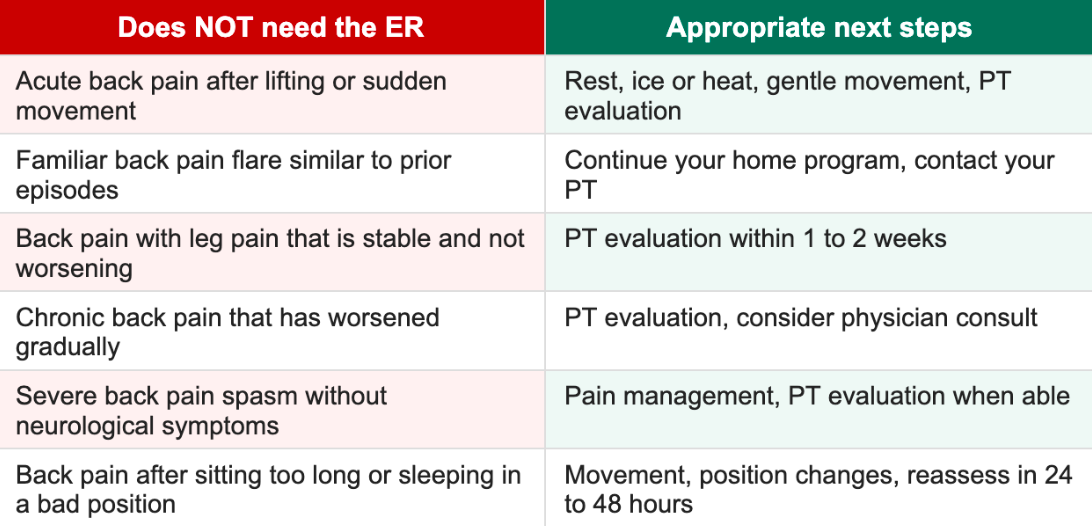
Severe pain alone is not a red flag. Back pain can be extraordinarily intense due to muscle spasm, disc herniation, or facet irritation, all without indicating a medical emergency. Pain intensity is a poor guide to urgency in the absence of the specific red flag symptoms listed above.
What the ER will and will not do for typical back pain
Will do: rule out serious structural causes, provide imaging if indicated, administer pain medication
Will not do: provide physical therapy, address the underlying mechanical cause, create a rehabilitation plan
For most non-emergency back pain, urgent care or a same-day telehealth physician visit followed by PT evaluation is faster, cheaper, and more clinically appropriate than an ER visit.
When Physical Therapy Is the Right First Step
Once red flags are ruled out, physical therapy is the evidence-based first-line treatment for most back pain presentations, including many that feel alarming. The following presentations are well-suited to PT as the primary intervention:
Acute low back pain, with or without mild leg symptoms, lasting less than 12 weeks
Chronic low back pain that has not responded to passive treatment alone
Disc herniation with radiculopathy that is stable or improving
Lumbar spinal stenosis with neurogenic claudication
Back pain with a clear mechanical pattern, symptoms that change with position or movement
Recurrent back pain episodes in someone who has had success with PT before
If you are unsure whether your symptoms warrant emergency evaluation or PT, the safest approach is to contact a healthcare provider who can help you triage. We are happy to help with that conversation in a discovery call and will tell you directly if we think you need a physician evaluation before starting PT.
Key Takeaways
Most back pain is musculoskeletal in origin and not dangerous, but a small number of presentations require emergency evaluation
True red flags requiring immediate ER care include loss of bladder or bowel control, saddle area numbness, rapidly progressive bilateral leg weakness, post-trauma pain, fever with back pain, and history of cancer with new spine pain
Progressive neurological symptoms warrant urgent physician evaluation within one to two days
Severe pain intensity alone is not a red flag in the absence of other concerning symptoms
The ER is not the appropriate setting for typical mechanical back pain and frequently results in imaging that creates more confusion than clarity
Once red flags are ruled out, physical therapy is the evidence-based first-line treatment for most back pain presentations
Frequently Asked Questions
What are the red flags for back pain that require emergency care?
The primary red flags requiring immediate emergency evaluation are loss of bladder or bowel control, numbness in the saddle area (groin and inner thighs), rapidly progressive leg weakness in both legs, back pain following significant trauma, fever above 101 degrees with back pain, history of cancer with new back pain, and sudden severe pain at full intensity. Any of these alongside back pain warrants going to the ER rather than waiting.
Is severe back pain a reason to go to the ER?
Not by itself. Back pain can be extremely intense due to muscle spasm, disc herniation, or facet irritation without indicating a medical emergency. Pain severity alone is a poor guide to urgency. What matters is whether you have any of the red flag symptoms alongside the pain. Severe pain without neurological symptoms, fever, trauma, or cancer history is appropriate for urgent care or telehealth physician evaluation rather than the ER.
What is cauda equina syndrome and why is it an emergency?
Cauda equina syndrome is compression of the nerve roots at the base of the spinal cord, most commonly from a large central disc herniation. Its hallmark symptoms are loss of bladder or bowel control and numbness in the saddle area. It is a surgical emergency because the window for intervention is narrow. Permanent loss of bladder, bowel, and sexual function can result if decompression is delayed. If you have these symptoms alongside back pain, go to the ER immediately.
Should I go to the ER or urgent care for back pain?
For red flag symptoms, go to the ER. For severe back pain without red flags, urgent care is often a more appropriate and efficient choice. Urgent care can evaluate for fracture, prescribe pain management, and refer you onward appropriately. For mechanical back pain without significant neurological symptoms, a telehealth physician visit or a direct PT evaluation is often the most efficient path.
My back pain woke me up at night. Is that serious?
Back pain that consistently wakes you from sleep, particularly if it is worse lying down than sitting or standing, warrants physician evaluation. This pattern can indicate inflammatory causes or, rarely, structural pathology that behaves differently from mechanical pain. A single episode of being woken by pain, particularly after an active day, is less concerning. A consistent pattern of night pain that does not improve with position change is worth having evaluated.
Back pain that is not an emergency but is not going away on its own?
Book a free 15-minute discovery call with us at Spine33 Rehab. We will talk through what you are experiencing and whether a telehealth spine rehab program is the right next step.
spine33rehab.com | Book Your Free Call
About the Author
Dr. Connor Sheeks PT, DPT is a licensed physical therapist and the founder of Spine 33 Rehab PLLC, a cash-pay telehealth physical therapy practice specializing in virtual spine rehabilitation. He holds a Doctor of Physical Therapy (DPT) degree and has clinical experience treating chronic low back pain, lumbar disc herniation and radiculopathy, cervicogenic headache, lumbar spinal stenosis, postural dysfunction, and many other spinal pathologies. Spine33 Rehab currently serves patients in Tennessee via telehealth and is actively pursuing licenses in other states.
References
Koes BW, et al. (2006). Diagnosis and treatment of low back pain. BMJ. doi:10.1136/bmj.38947.583970.AE
Della-Giustina D. (2015). Evaluation and treatment of acute back pain in the emergency department. Emergency Medicine Clinics of North America. doi:10.1016/j.emc.2014.09.009
Deyo RA, Diehl AK. (1988). Cancer as a cause of back pain: frequency, clinical presentation, and diagnostic strategies. Journal of General Internal Medicine. doi:10.1007/BF02596337
Greenhalgh S, Selfe J. (2006). Red Flags: A Guide to Identifying Serious Pathology of the Spine. Churchill Livingstone.
Todd NV. (2011). Cauda equina syndrome: the timing of surgery probably does influence outcome. British Journal of Neurosurgery. doi:10.3109/02688697.2011.558055